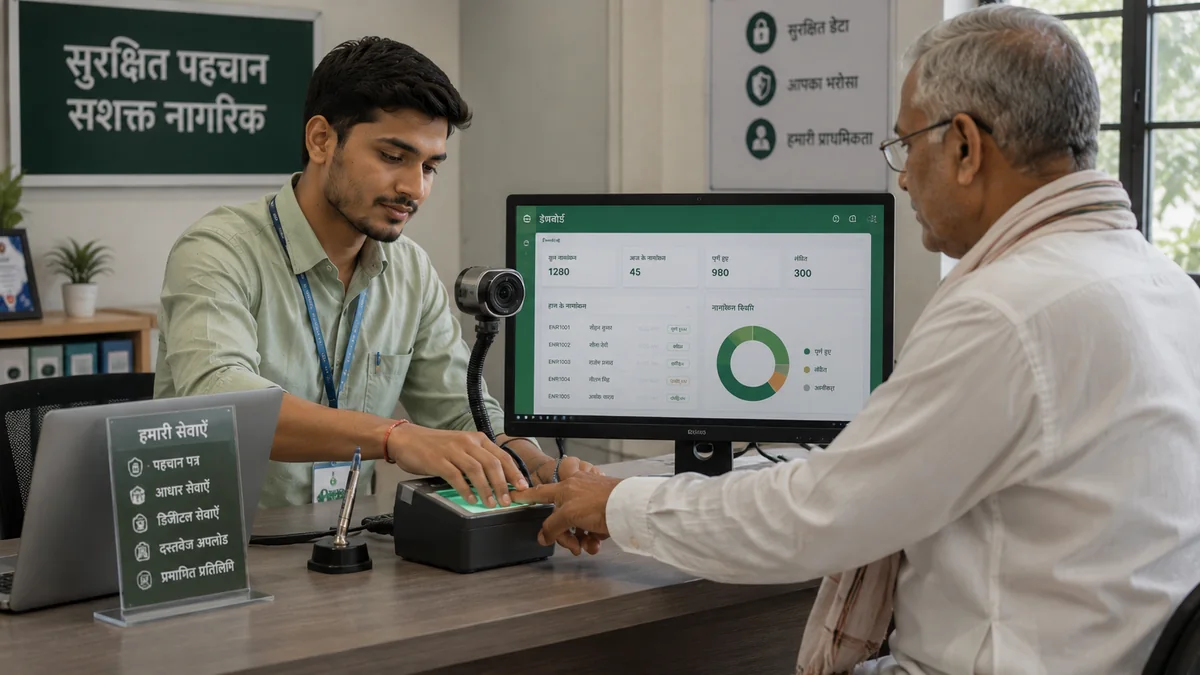
What is an Aadhaar Seva Kendra?
An Aadhaar Seva Kendra is a centre authorised by the Unique Identification Authority of India (UIDAI) to deliver Aadhaar-related services to citizens. Operators handle three main flows:
- New enrolment — first-time issue of an Aadhaar number, including biometric capture (fingerprints, iris, face).
- Updates — name, address, date of birth, phone, email, and biometric refreshes for citizens whose Aadhaar is older than ten years or who have changed personal details.
- Verification & reprints — paper Aadhaar reprints, downloads, and verification checks for citizens who need a fresh copy.
Many Aadhaar Seva Kendras also operate as full Common Service Centres (CSCs) under the Aaple Sarkar / Maha e-Seva umbrella, handling caste certificates, ration card services, and bill payments alongside the Aadhaar work. Either way, the operator's day is dominated by data: collecting documents, verifying identities, queueing applications, and answering "where is my Aadhaar?" the next week.
What software does an Aadhaar Seva Kendra need?
The official UIDAI Aadhaar Enrolment Client handles the regulated bit — capturing fingerprints and submitting them to UIDAI servers. By regulation, that cannot be replaced. But it does only one job, and the rest of the operator's day is uncovered:
- Application tracking. A citizen comes in for an address update on Tuesday. They come back on Friday asking "is it done?" — and the operator needs an answer, not a guess from a paper notebook.
- Document storage. Aadhaar update requires proof — utility bills, bank passbooks, ration cards. Where do those scans live? Most operators use a folder named "Aadhaar 2026 May" on a desktop. That breaks the moment the desktop dies.
- Family records. Father wants an Aadhaar update. His son comes in two weeks later for a new enrolment. Same address, same family — but the operator re-keys everything because the platform doesn't connect them.
- Receipt & billing. The operator charges a service fee on top of the UIDAI fee. The citizen wants a printed receipt. The operator wants a daily collection report.
- PII protection. Aadhaar numbers, phone numbers, addresses — under the DPDP Act 2023 these legally need to be encrypted at rest, with access logged. Most off-the-shelf tools don't do this.
Digi SetuSeva is built for those five jobs. The UIDAI client keeps doing what only it can do; everything around it is the platform.
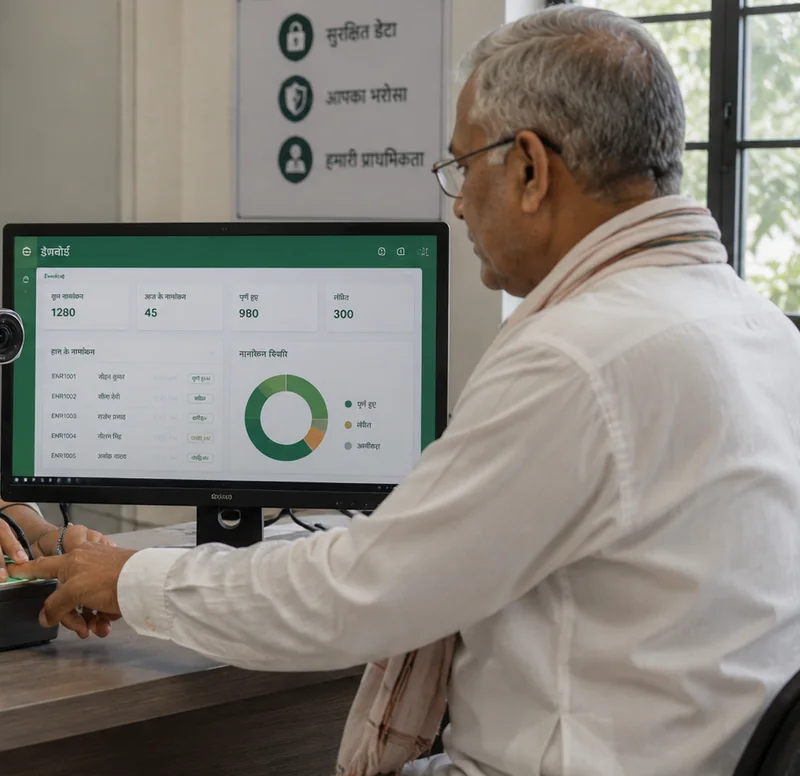
What Digi SetuSeva offers an Aadhaar Seva Kendra
- Aadhaar & PAN OCR. Scan a citizen's Aadhaar with a laptop camera or document scanner — the platform reads the number, name, date of birth, and address. Recognises both Devanagari (Marathi / Hindi) and Latin (English) scripts on the same card.
- AES-256-GCM field-level encryption. Aadhaar number, phone, address, and other PII fields are encrypted at the database row before being written. Even if the database is exposed, the data isn't.
- Audit log on every PII access. The platform records who read or wrote any encrypted field, when, and from which device. If a DPDP Act inquiry asks "who accessed this citizen's Aadhaar between dates X and Y", the answer is one query away.
- Cloud-based — access from any device. Open Digi SetuSeva in any browser at the counter, the back office, or on your phone, and you are always on the same live records. Everything is backed up automatically, so a lost or replaced computer never means lost citizen data.
- Application tracker with state machine. Each citizen request moves through defined states (intake → submitted → in process → ready → collected). The "ready for collection" view lets the operator answer the door without scrolling.
- Document storage on Cloudflare R2. Scanned proof documents live in S3-compatible storage, indexed by citizen and application. Searchable by name, family, or service.
- Bilingual Marathi + English UI. Switch language at any time. Receipts can be printed in either.
- Nothing to install. Digi SetuSeva runs entirely in the browser — no setup, no licence files, and no manual updates to run. You are always on the latest version.
DPDP Act 2023 — what changed and what we built
India's Digital Personal Data Protection Act 2023 places legal obligations on anyone who collects, processes, or stores citizen personal data. That includes a small Aadhaar Seva Kendra running in a town. The Act asks for, among other things:
- Consent and purpose limitation — the citizen has to know why their data is being collected and consent specifically to that purpose.
- Encryption of stored data — PII at rest must be protected from unauthorised access.
- Breach notification — if data is exposed, the operator and the data principal both have to be informed.
- Data-subject rights — citizens can request access to their data, ask for corrections, or request deletion.
- Audit trail — operators must be able to produce a record of who accessed what data and when.
Digi SetuSeva is built around these principles. PII is encrypted by default. Every read and write is logged. Citizen records have a structured "request data" / "request deletion" flow. Receipts contain only the minimum data needed. Nothing is stored that isn't necessary for the service.
This isn't a "bolt-on compliance module." It is the foundation the platform sits on, because the Act is too new for any of the earlier-generation CSC tools to have been designed for it.
How citizen data is encrypted
Every PII field — Aadhaar number, phone, address, date of birth, family details — is encrypted using AES-256-GCM at the application layer before it is written to the database. Encryption keys are managed in a hierarchy: a per-tenant master key wraps per-record data keys, so a single key compromise does not expose the whole dataset.
On read, the field is decrypted only inside the operator's session, only for the duration of the page render, and the access is logged. The database operator (Supabase / Postgres) never sees the plaintext. If the database is dumped — by accident or attack — the dump contains ciphertext, not citizen data.
Combined with the drive.file-only Google OAuth scope (the platform can read only the documents it created itself, never your other files) and the audit log, this is meaningfully stronger PII protection than what a typical CSC kiosk runs today.
Does this replace the UIDAI Aadhaar Enrolment Client?
No. The UIDAI Aadhaar Enrolment Client must still be used for any biometric capture or submission to UIDAI servers — that is fixed by regulation and cannot be swapped. Digi SetuSeva sits alongside the UIDAI client and handles everything else: tracking the citizen visit, storing supporting documents, billing, receipts, family records, and the audit trail the DPDP Act now requires.
Think of the UIDAI client as the certified instrument that captures the biometric. Digi SetuSeva is the operating system around it.
Pricing
- ₹1,500 one-time registration — includes ₹500 prepaid wallet credit, enough for 166 receipts.
- ₹3 per issued receipt after that, debited from your prepaid wallet.
- No monthly fee, no subscription — an idle month costs ₹0.
No per-citizen charge. No per-document charge. No "contact sales for pricing" tier. Full breakdown on the pricing page.
How to get started
- Create an operator account at digisetuseva.in/auth/register. Two minutes.
- Set up your Aadhaar Seva Kendra — kiosk address, the services you offer, your service charge, your receipt language preference.
- Process your first citizen. Scan their Aadhaar (the OCR pre-fills the form), pick the service, print the receipt, queue the application. Update the application status as the work moves through.
Frequently asked questions
What is an Aadhaar Seva Kendra?
A UIDAI-authorised centre where citizens enrol for an Aadhaar number, update their existing details, or get a printed Aadhaar letter. Run by an operator who collects documents, captures biometrics on UIDAI-supplied hardware, and submits the request through the official UIDAI client.
Is Digi SetuSeva a replacement for the UIDAI client?
No. The official UIDAI Aadhaar Enrolment Client must be used for biometric capture and submission — that is fixed by regulation. Digi SetuSeva handles everything else: application tracking, document storage, billing, family records, and the audit log the DPDP Act now requires.
How does Digi SetuSeva protect Aadhaar data?
Aadhaar numbers, phone numbers, addresses, and other personally identifiable fields are encrypted at the field level using AES-256-GCM before they are written to the database. Decryption keys are held in a hierarchy that is rotated regularly, and every read or write of an encrypted field is recorded in an audit log.
What is the DPDP Act 2023 and why does it matter?
India's Digital Personal Data Protection Act 2023 places legal obligations on anyone — including small Aadhaar Seva Kendra operators — who collects, processes, or stores citizen personal data. Failure to comply carries penalties. The Act requires consent, encryption, breach notification, and data-subject rights. Digi SetuSeva is built around these principles.
Does the Aadhaar OCR work in Marathi?
Yes. The OCR recognises both Devanagari (Marathi / Hindi) and Latin (English) scripts on the same Aadhaar card and pre-fills the application form accordingly.
Do I need to install anything to use Digi SetuSeva?
No. Digi SetuSeva runs in any modern web browser — Chrome, Edge, or Firefox — so there is nothing to download or install. Your data is stored in a secure, encrypted cloud database and backed up automatically, so it is safe even if your computer is lost or replaced, and you can reach it from any device. An internet connection is required, the same as the UIDAI client and the Aaple Sarkar portal you already use.
How much does Digi SetuSeva cost for an Aadhaar Seva Kendra?
One-time registration of ₹1,500 (includes ₹500 wallet credit — 166 receipts), then ₹3 per issued receipt. No monthly fee, no per-citizen charge, no per-document charge.