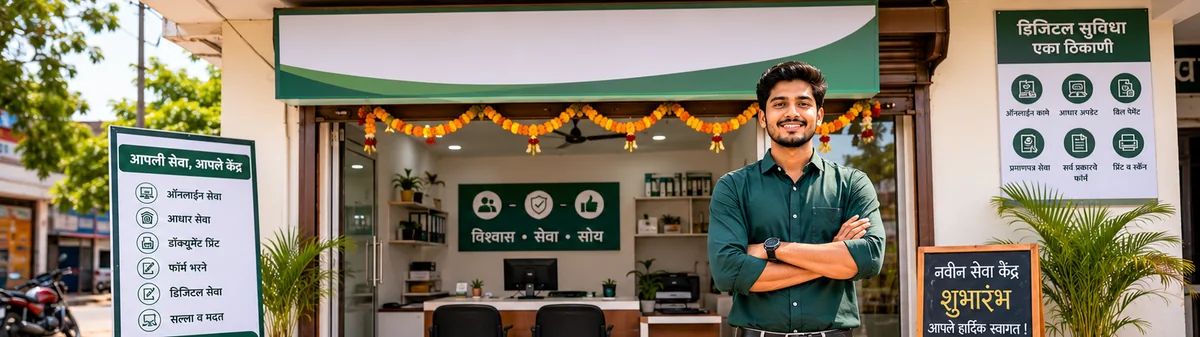
CSC vs Aaple Sarkar Seva Kendra — pick which (or both)
The first decision is which programme to register under. They are distinct schemes with different governing bodies:
- Common Service Centre (CSC). A central-government scheme run by CSC e-Governance Services India Ltd. Delivers a national catalogue: PAN applications, passport seva, banking correspondent (BC) services, BBPS bill payments, IRCTC ticket booking, insurance, and more.
- Aaple Sarkar Seva Kendra. A Maharashtra state programme that delivers state-specific services: caste, income, domicile, residence, and non-creamy-layer certificates; ration card services; ROR / 7/12 land records; Maha e-Seva applications.
In practice, most operators in Maharashtra register for both and run them from the same kiosk on the same computer. Citizens don't think in terms of programmes — they walk in and ask for the service they need. Restricting yourself to one programme means turning away half the foot traffic.
Eligibility & required documents
Who can apply:
- Indian citizen, age 18 or above
- Class 10 (SSC) pass or higher
- Reads and writes Marathi or Hindi
- Basic computer literacy (typing, web browsing, file management)
- Resident of the area where the kiosk will operate
- Clean police record (no serious criminal cases)
Documents you'll need ready:
- Aadhaar card
- PAN card
- Class 10 marksheet (or higher)
- Recent passport-size photograph (digital)
- Address proof for the kiosk (electricity bill, rent agreement, or property document)
- Mobile number linked to Aadhaar (used for OTP at every step)
- Active email address
- Bank account in your name (for receiving operator commissions)
- Cancelled cheque or bank passbook front page (for bank account verification)
The 6-step registration process
Step 1 — Complete the TEC certification
The Telecentre Entrepreneur Course (TEC) is a mandatory online certification for anyone applying to be a CSC VLE. It is run by NIELIT and the application starts at cscentrepreneur.in. The fee is around ₹1,479 + GST (verify current fee on the portal). After registration you receive course access; the modules cover digital service delivery basics, citizen handling, and CSC's service catalogue. The exam is online; on passing you receive a TEC certificate number.
Time: 1–3 weeks depending on how many hours per day you can study.
Step 2 — Register on the Apna CSC portal
With your TEC number in hand, register at register.csc.gov.in. You will need to upload all the documents listed above, capture a live photograph, and select a service location (district, taluka, village/ward). Submission triggers a review by the CSC district manager.
Time: 2–4 weeks for review and approval.
Step 3 — Apply for Aaple Sarkar Seva Kendra
Separately, register on the Aaple Sarkar portal as a Seva Kendra operator. The required documents overlap heavily with the CSC application, so most of the prep is reusable. Aaple Sarkar grants approval through the local government office.
Time: 2–3 weeks; can run in parallel with Step 2.
Step 4 — Receive your VLE ID and credentials
On approval, the CSC Digital Seva portal issues a Village Level Entrepreneur (VLE) ID and login credentials. Aaple Sarkar issues its own operator login. Keep both sets of credentials safe — they unlock access to the citizen-facing service portals.
Step 5 — Set up the kiosk
While waiting for approvals, get the physical kiosk ready. Hardware list and budget below in the hardware section. Don't skip the UPS — power cuts in rural Maharashtra are routine and an in-progress citizen application that crashes mid-submission costs you a customer.
Step 6 — Activate services and start
Log into Digital Seva and Aaple Sarkar with your new credentials, configure the services you want to offer, set your operator service charge per service, and you're live. The first week is for learning the portal flows; by week two you'll have your own routine.
Hardware setup and what it costs
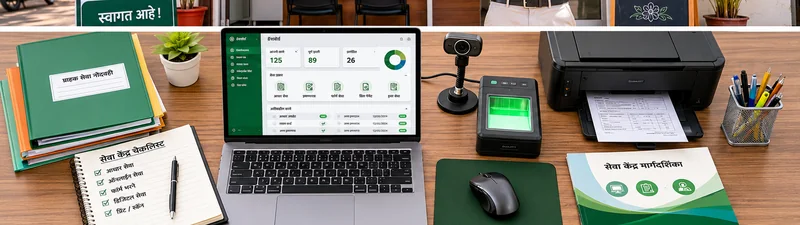
A working CSC kiosk in 2026 typically needs:
- Desktop computer or laptop (Windows 10/11, 8 GB RAM, 256 GB SSD): ₹25,000–₹45,000
- Biometric fingerprint scanner (Mantra MFS-100 or equivalent, STQC-certified): ₹2,500–₹4,500
- Web camera (for citizen photograph): ₹800–₹2,000
- Document scanner or multi-function printer with scanner (Epson L3250 / Canon Pixma G2010 class): ₹12,000–₹20,000
- UPS (uninterruptible power supply): ₹3,000–₹6,000 — non-negotiable in rural Maharashtra
- Internet connection (fibre preferred; 4G dongle as backup): ₹500–₹1,200/month recurring
- Furniture (table, two chairs, citizen waiting bench, cabinet): ₹5,000–₹15,000
- Signage (for the shopfront): ₹1,500–₹4,000
Realistic upfront total: ₹50,000–₹95,000. Going lower than ₹40,000 usually means cutting corners that will hurt you within months — slow computer, unreliable scanner, no UPS.
Realistic monthly income
Income depends on three things: where the kiosk is, what services you offer, and how many citizens you handle per day. Some honest ranges from operators in Maharashtra:
- Rural village, 30–50 citizens/day, certificate-heavy mix: ₹15,000–₹25,000/month after expenses
- Small town, 50–80 citizens/day, mixed services + bill payments: ₹25,000–₹45,000/month
- Urban kiosk, 80–150 citizens/day, full services + BBPS + insurance: ₹45,000–₹80,000/month
- Multi-operator urban centre with PAN service + DigiPay + 200+ citizens/day: ₹80,000+/month, with multiple staff
The biggest income lever is service mix. A kiosk that only does government certificates earns less than one that adds BBPS bill payments, banking correspondent (BC) services, insurance, and railway/bus tickets. Per-transaction commissions on the financial services compound much faster than one-off certificate fees.
Common mistakes new operators make
- Picking a saturated location. Two CSCs already exist within 200 metres of yours? You'll fight for table scraps. Do a 1 km foot survey before signing the rent agreement.
- Skipping the UPS. Submitted half a citizen's Aadhaar update when the power dies, you lose the work and the citizen. ₹3,000 spend that pays for itself in the first power cut.
- Not tracking applications. The citizen comes back asking "where is my certificate?" three days later. If you're scrolling through a paper notebook to find their name, you've already lost their trust.
- Storing scanned Aadhaar on the desktop. Under DPDP Act 2023 this is a legal exposure. Citizen PII needs to be encrypted at rest, and access has to be auditable.
- Promising delivery dates you don't control. Government certificate timelines are not yours to set. Promise "I'll submit within 24 hours and update you on progress" — not "you'll get it Friday."
Software you'll want from day one
The official portals (CSC Digital Seva, Aaple Sarkar, the UIDAI Aadhaar Enrolment Client) handle the regulated bits. They don't help you with the rest of your day:
- Tracking which citizen requested what, and what stage their application is at
- Storing supporting documents the citizen brings, organised by family
- Printing receipts with your service charge
- Managing repeat-visit families so you're not retyping addresses every time
- Encrypting citizen PII as DPDP Act 2023 requires
- Keeping all of this backed up and reachable from any device, not trapped on one computer
Digi SetuSeva handles all six in a single cloud-based app for a one-time ₹1,500 registration (which includes ₹500 of prepaid wallet credit) and then just ₹3 per issued receipt — no monthly fee. It runs in any browser — nothing to install — with your data encrypted and backed up automatically, reachable from any device. Bilingual Marathi + English. There are alternatives — VLE Plus, SmartCSCTools, generic billing apps stretched to fit — but most don't ship with field-level encryption or DPDP Act 2023 compliance.
Frequently asked questions
Who is eligible to become a CSC operator in Maharashtra?
Indian citizens above 18 years of age who have passed at least Class 10 (SSC), can read and write Marathi or Hindi, and have basic computer literacy. The applicant must be a resident of the area where the centre will operate, hold a valid Aadhaar and PAN, and have a clean police record.
What is the difference between a CSC and an Aaple Sarkar Seva Kendra?
CSC is a central-government scheme delivering a national service catalogue (PAN, BBPS, banking correspondent, insurance, etc.). Aaple Sarkar is the Maharashtra state-government parallel that delivers state-specific services (caste, domicile, ration card, Maha e-Seva). Most operators register for both and run them from the same kiosk.
How much does it cost to set up a CSC kiosk in Maharashtra?
Total upfront cost typically ranges from ₹40,000 to ₹1,20,000. Hardware (computer, biometric scanner, printer, web camera) accounts for ₹35,000–₹70,000. Furniture, signage, and a UPS add ₹5,000–₹15,000. Registration fees on the official portals are minimal (₹1,000–₹5,000 depending on the scheme). Verify current fee schedules on the official portals before paying.
What is the TEC and is it mandatory?
TEC stands for Telecentre Entrepreneur Course — a mandatory online certification for CSC VLE applicants in India. Delivered through NIELIT, costs around ₹1,479 + GST. Candidates have a few weeks to complete the modules and pass the exam, which yields a TEC certificate number used in the CSC application.
How long does it take to become a CSC operator?
Realistically four to eight weeks from start to first transaction. TEC certification: 1–3 weeks. CSC application review: 2–4 weeks. Aaple Sarkar registration overlaps. Hardware procurement and kiosk setup: 1–2 weeks, can run in parallel.
How much does a CSC operator earn in Maharashtra?
Income varies widely by location and services offered. A rural operator handling 30–50 citizens a day typically earns ₹15,000–₹40,000 per month after expenses. Urban operators with higher footfall and more services can exceed ₹60,000. Operators who add bill payments and BBPS services earn substantially more from per-transaction commissions than from one-off certificates alone.
Do I need to be fluent in Marathi to become an operator in Maharashtra?
Practically yes. The majority of citizens speak Marathi as their first language and government certificates are issued in Marathi by default. The official application portals also have a Marathi interface. Operators who don't read Marathi struggle with citizen-facing work even if their personal English is strong.